Keyboard Options dialog
The Keyboard Options dialog is used to map BlueZone UTS program functions to key sequences on the keyboard.
From the BlueZone menu bar, click or click the Keyboard icon  on
the BlueZone toolbar. The Keyboard Options dialog opens, which contains
the Key Mappings (a bitmap image of a keyboard), Options,
and More Options tabs.
on
the BlueZone toolbar. The Keyboard Options dialog opens, which contains
the Key Mappings (a bitmap image of a keyboard), Options,
and More Options tabs.
Refer to Mapping keyboards for more information.
Key Mappings tab
Note: If you have installed
a non-English version of BlueZone, the default keyboard map that will
be displayed is based on your currently selected language in the Regional
and Language Options in Windows.
- Gray keys
- Gray keys can be mapped. If you click a gray key, the Key Info/Mappings
window opens and lists all of the key mappings for each function group.
It also lists any combination key mappings that this key is used in.
The following figure shows the associated mappings with the V key. The Ctrl key is mapped to the Edit::PasteMenu Hotkeys. All of the other available mappings are unmapped.
Figure 1. BlueZone UTS key mappings information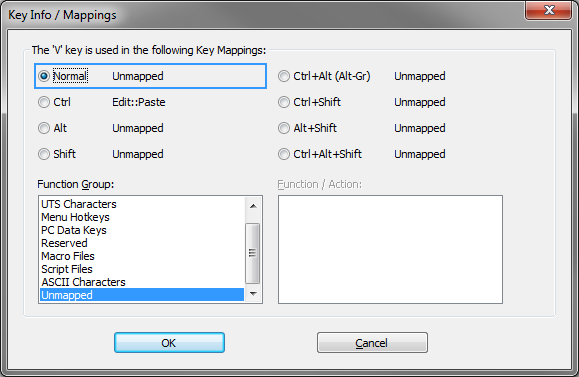
- Red keys
- Red keys cannot be used to map BlueZone UTS Functions.
- Yellow keys
- Yellow keys are caution keys. Care should be taken when using the yellow keys to map BlueZone UTS Functions. The caution keys include the Alt keys and the Esc key. Windows uses the Alt keys with menu accelerators and the Esc key is mapped to Esc.
- Options
- Keyboard Type: A drop-down menu that contains
a list of keyboard options for BlueZone. Select the type of keyboard
required for your display:
- Default
- Unicomp 0852-M 122 Key
- KeyTronic KB3270/Plus
Dutch
French
German
Japanese
United States
United States-International
Note: If you select either the Unicomp 0852-M 122 Key or the KeyTronic KB3270/Plus keyboard, a 122 Keys button displays in the upper right hand corner of the dialog. Click this button to display a floating keyboard bitmap of the extended keys. - Functions Group: Lists the various groups
of keyboard functions that are available for keyboard mapping.
- UTS Functions: Used to map UTS Terminal related functions like the Arrow Keys, Clear Keys, F1 through F10, Home, Insert Line, Local, and so on.
- UTS Characters: Used to map special UTS characters like the Cent Sign, Logical Not and Solid Vertical Bar.
- Menu Hotkeys: Lists the BlueZone menu items available for key mapping.
- PC Data Keys: Lists the PC Keyboard Keys available for key mapping, like Broken Vertical Bar, Degree Sign, Plus Sign, Minus Sign, Euro Currency Symbol, and so on.
- Macro Files: Lists the macro files available
for key mapping. BlueZone macro files are created by clicking from
the BlueZone menu bar. Note: Only macro files from the BlueZone program directory are listed for selection.
- Script Files: Lists the script files available
for key mapping. BlueZone script files are created by clicking from the BlueZone menu bar. Note: Only script files from the BlueZone program directory are listed for selection.
- Functions: Lists the various functions available for key mapping. The functions displayed are dependent on which function is selected in the Functions Group list box.
- Key Mappings: Lists the key mapping or mappings if any, that execute the highlighted function in the Functions List Box.
- Keyboard Type: A drop-down menu that contains
a list of keyboard options for BlueZone. Select the type of keyboard
required for your display:
- Key Mappings Buttons
- Print: Allows you to print out the mappings for whatever is displayed in the Keyboard Functions Group list box. For example, if you want a printout of all the UTS keyboard functions and what keys they are currently mapped to, ensure that UTS Functions is in the Functions Group box and click Print.
- New: Adds a new key mapping entry to the
Key Mappings list box. Note: Functions can be mapped to more than one key.
- Edit: Edits the highlighted key mapping entry.
- Delete: Removes the highlighted key mapping entry from the Key Mappings list box.
- OK: Accepts the key mapping and assigns it to the UTS Function.
- Cancel: Cancels the key mapping.
Options tab
- Options
- Auto-Reset when keyboard is locked (an audible sound
will be heard): If enabled, the UTS Function Reset is
automatically executed if the keyboard state becomes locked with an
“X Error” condition.
- Auto Tab After Reset: If enabled, an Auto-Tab is issued immediately after the keyboard is unlocked by the Auto-Reset feature above. The purpose of this feature is to automatically bring the cursor to the closest field of entry.
- Immediate Auto-Reset: If enabled, the Auto-Rest is issued immediately.
- Auto-Rest when Next Key is Pressed: If enabled, the Auto-Rest is issued only after a key is pressed.
- Auto-Reset when keyboard is locked (an audible sound
will be heard): If enabled, the UTS Function Reset is
automatically executed if the keyboard state becomes locked with an
“X Error” condition.
More Options tab
- Options
- Hard-Map Print Screen Key to Menu Hotkey File→ Print
Screen: If enabled, the UTS Function Print Screen executes
when pressing the Print Screen key on the keyboard. Note: The Print Screen key is a system key and causes Windows to copy the contents of the desktop clipboard.
- Auto-Repeat Mode for Ctrl, Alt and Shift Keys: If enabled, the Ctrl, Alt, and Shift keys auto-repeat while continuously pressed.
- Auto-Repeat Mode for Enter Keys: If enabled, the Enter keys auto-repeat while continuously pressed.
- Auto-Repeat Mode for Function Keys: If enabled, the Function keys auto-repeat while continuously pressed.
- Hard-Map Print Screen Key to Menu Hotkey File→ Print
Screen: If enabled, the UTS Function Print Screen executes
when pressing the Print Screen key on the keyboard.